The Making of a Kashmiri Masterpiece: Engineering a 100-Year Legacy »
The creation of an authentic Kashmiri hand-knotted rug is not merely a manufacturing process; it is a meticulous multi-year journey where 15th-century artistry meets advanced material science. Introduced by Sultan Zain-ul-Abidin in the early 1400s, this craft (locally known as Kal-baffi) has survived centuries by adhering to a rigorous technical standard that modern machinery cannot replicate. From the biological selection of Grade 6A Mulberry silk to the alchemical finishing in the Srinagar Valley, every carpet we produce is a testament to the concept of Time as a Raw Material.
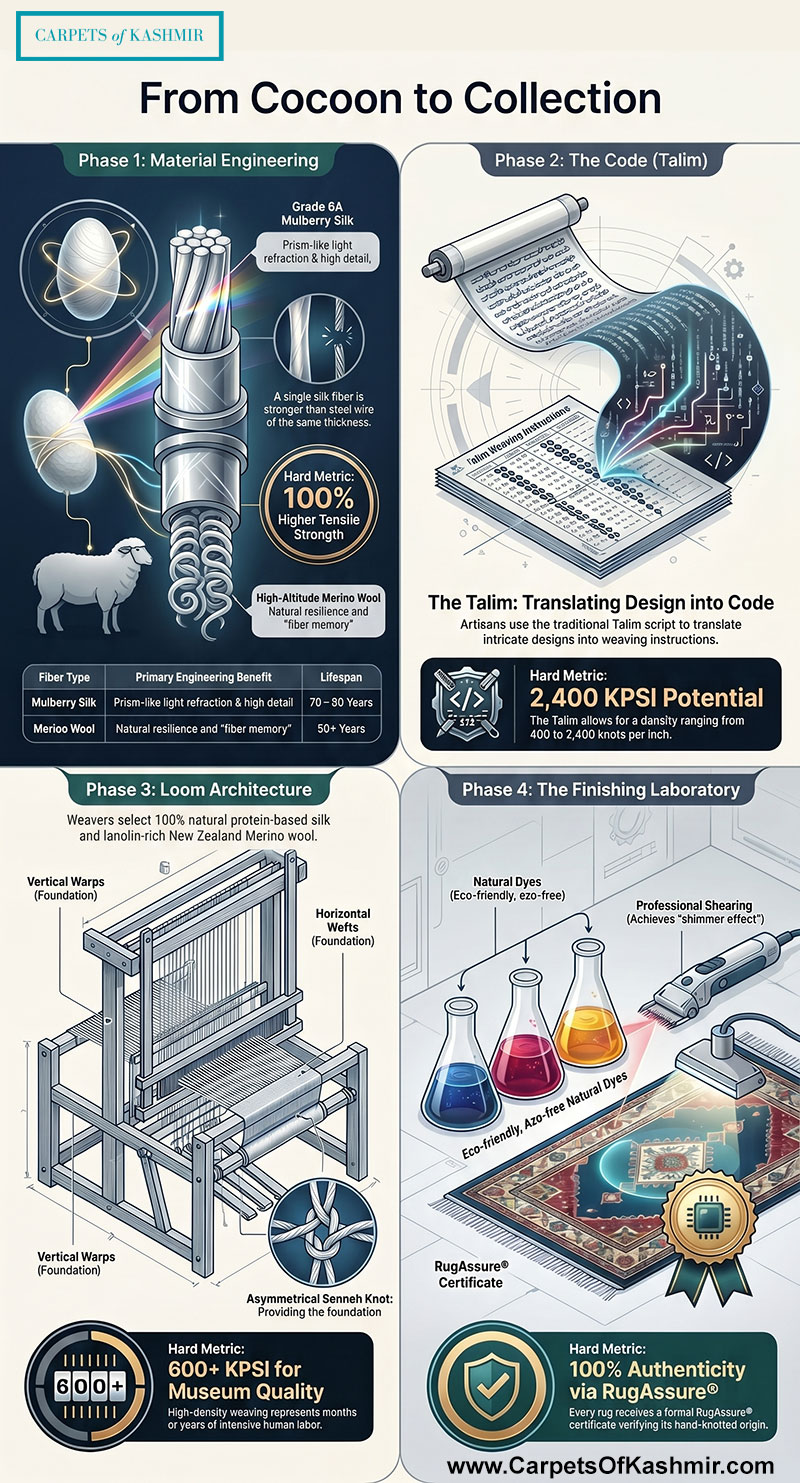
From Cocoon to Collection: The 4 Phases of Kashmiri Rug Engineering »
Material Science: Why the Foundation Determines the Heirloom »
The durability of a heritage rug begins at the molecular level. We utilize two primary “high-performance” natural fibers:
1. Grade 6A Mulberry Silk (The Shimmering Prism)
Derived from the Bombyx mori silkworm, our silk is exclusively Grade 6A—the global gold standard representing only the top 5% of silk production. Its triangular prism-like fiber structure allows for optical scattering, creating the signature metallic sheen. With a tensile strength exceeding that of steel wire of equal thickness, these protein fibers allow for ultra-fine knotting without structural fatigue.
2. High-Altitude Merino Wool (The Matte Anchor)
Sourced from high-altitude breeds, our wool is prized for its high lanolin content. Lanolin acts as a microscopic hydrophobic barrier, naturally repelling liquid spills. The fibers possess a “natural crimp” or structural memory, which prevents permanent indentations from heavy mahogany furniture—a property synthetic viscose and rayon cannot provide.
The Talim Script: Decoding the “Software” of the Loom »
While most global weaving traditions rely on visual maps, the Kashmiri masterpiece is “coded.” The Talim is a handwritten script of artisanal cryptography that translates the Nakaash’s (designer’s) vision into a line-by-line weaving code.
- The Code: Each symbol in the Talim represents a specific color and a precise number of knots. It functions as the “binary code” of the loom.
- The Caller & Weaver: In a traditional Karkhana (workshop), a master caller chants the instructions while the weavers tie the knots in a synchronized rhythm. This oral-technical fusion ensures that even at 2,400 KPSI, the design remains mathematically perfect.
Frequently Asked Questions: Authentic Kashmiri Craftsmanship »
How can I distinguish a hand-knotted rug from a hand-tufted one?
Answer: Flip the rug. In a hand-knotted rug, the design is clearly visible on the reverse side as a mirror image of the front, because each individual knot is tied around the warp. In hand-tufted rugs, the back is covered with a canvas or latex coating to hide the glue used to hold the fibers—this is a mass-produced item with zero investment value.
What is “The Khar” and why is it essential for silk rugs?
Answer: The Khar is the finishing alchemical wash. Authentic rugs are washed in the mineral-rich waters of the Srinagar valley using pH-balanced natural detergents. This process strips any excess dye and “polishes” the silk filaments, activating the metallic-like glow and setting the dyes for the next 80 years.
Why does a 600 KPSI rug take longer to weave than a 200 KPSI rug?
Answer: Knot density is exponential. A 600 KPSI rug has nine times the number of knots per square inch as a 200 KPSI rug. Each knot is tied by hand; therefore, a high-density rug represents thousands of additional hours of labor, resulting in a finer design “resolution” and far greater structural durability.
Are the dyes used in Kashmiri rugs safe and eco-friendly?
Answer: Yes. At Carpets of Kashmir, we utilize Azo-free, chrome-free Swiss dyes and traditional vegetable pigments. This ensures the fibers are hypoallergenic and 100% biodegradable, safe for homes with sensitive skin and environmentally sustainable.